%20(4)_ai.png)
Rosehip Oil: Nature's Secret for Skin That Heals Itself
Rosehip oil comes from the seeds of wild rose bushes — tiny, unpretentious fruits that appear after the roses have bloomed and faded. What those seeds contain is extraordinary: a concentration of nutrients that the skin recognises immediately and absorbs deeply.
It has been used for centuries by ancient Egyptians, Mayans and Native Americans. All of them found their way to Rosehip oil long before science could explain why it worked. They simply noticed that it did.

What Rosehip oil actually is
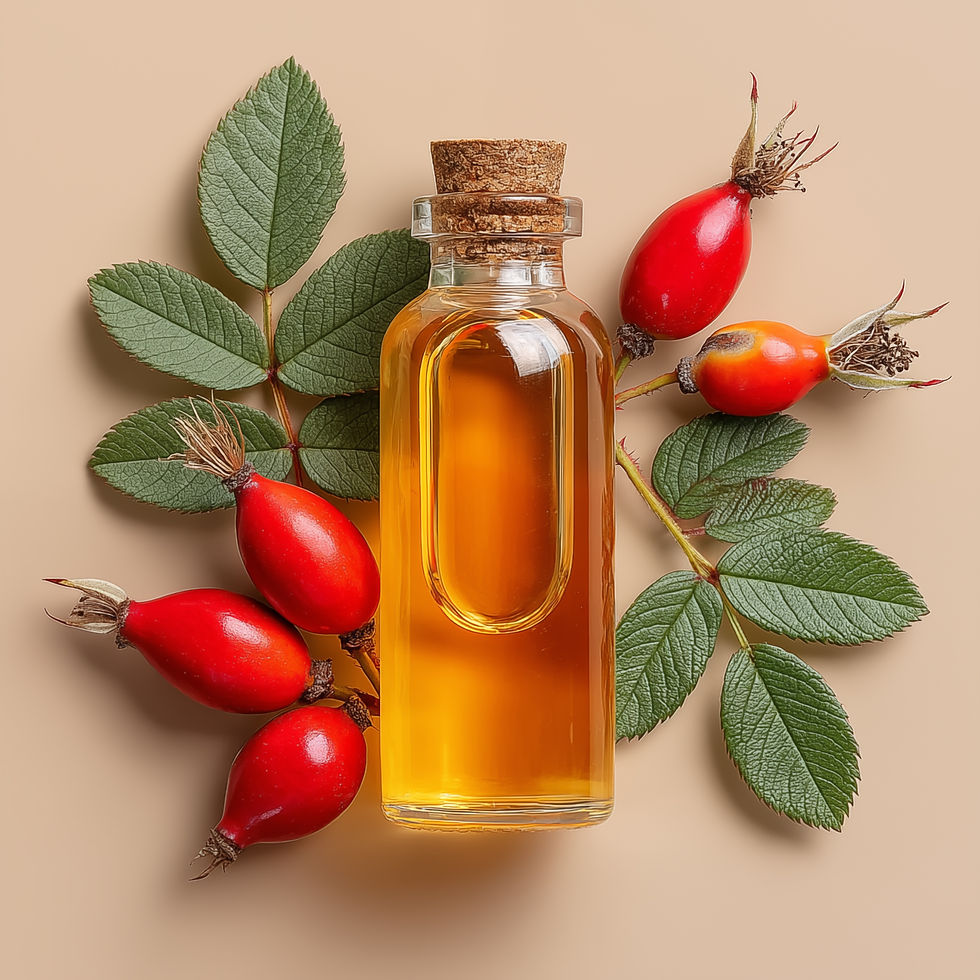
Rosehip oil is a dry, lightweight oil cold-pressed from the seeds of the rose plant — most commonly Rosa canina or Rosa rubiginosa. These are wild rose varieties that grow in the cooler regions of Europe, South America and parts of Africa.
It is not to be confused with Rose essential oil, which is distilled from the flower petals and has a completely different composition and purpose. Essential oils are very potent and can only be used safely in a very tiny amount. Essential oils must be dissolved in a carrier oil to be used safely in skincare and wellness products. Rosehip oil comes from the seed, not the petal — and it is this that gives it its remarkable skin-renewing properties.
The oil is naturally rich in:
Essential fatty acids — particularly linoleic acid (omega-6) and alpha-linolenic acid (omega-3), which are the building blocks of healthy skin cell membranes
Vitamin A — in the form of trans-retinoic acid, which supports cell turnover and collagen production
Vitamin C — a potent antioxidant that supports skin brightness and protects against oxidative stress
Vitamin E — which nourishes, protects, and helps the skin retain moisture
Beta-carotene — which gives the oil its characteristic warm golden-orange colour
This combination makes Rosehip oil one of the most nutrient-dense oils available for the skin — and one of the few plant oils that works at a cellular level rather than just on the surface.
What it does for the skin
It supports cell renewal
The skin renews itself constantly — old cells are shed and new ones take their place. But this process slows down with age, stress, and environmental damage. Rosehip oil, with its natural vitamin A content, gently encourages the skin to keep renewing. The result, over time, is skin that looks and feels fresher, clearer and more alive.
This is not an overnight transformation. It is a gradual process — the kind that happens quietly, consistently, and deeply. Most people notice a difference after four to six weeks of regular use.
It fades scars and hyperpigmentation
This is perhaps what Rosehip oil is most widely known for. The essential fatty acids and vitamin A work together to support the skin in repairing damaged tissue — gently fading the marks left by acne, sun exposure, pregnancy, surgery, or simply the passage of time.
The mechanism is straightforward: vitamin A encourages the production of new, healthy skin cells, while the essential fatty acids provide the raw materials the skin needs to rebuild. Together, they support the skin in doing what it is already trying to do — heal.
It nourishes deeply without clogging pores
Because Rosehip oil is a dry oil — meaning it absorbs quickly and completely — it delivers deep nourishment without leaving a greasy residue or blocking pores. This makes it suitable for almost all skin types, including oily and combination skin, which is relatively rare for a nourishing oil.
The skin does not need to work hard to absorb it. It simply recognises the fatty acids as its own building blocks and draws them in.
It softens fine lines and supports elasticity
The essential fatty acids in Rosehip oil are the same ones the skin uses to maintain its own structure. When the skin becomes deficient in these — as it often does with age, stress, or prolonged sun exposure — it loses elasticity and begins to show the signs of wear.
Rosehip oil replenishes what has been lost. With consistent use, the skin becomes more supple, more resilient, and better able to hold its own natural moisture.
It calms inflammation
For skin that is reactive, sensitive, or prone to redness, Rosehip oil offers something else entirely. Its natural anti-inflammatory compounds help to calm the skin and reduce irritation — making it gentle enough to use on compromised, post-procedure, or healing skin.
It is one of the reasons Rosehip oil has historically been used to support scar healing after surgery or injury. The skin needs both nourishment and calm to repair itself well — and Rosehip oil provides both.
How to choose a good Rosehip oil
Not all Rosehip oils are equal. The quality varies significantly depending on how the oil is extracted and how it is stored.
Cold-pressed is best. Heat extraction is faster and cheaper, but it destroys many of the delicate fatty acids and vitamins that make Rosehip oil valuable. Cold-pressing preserves them.
Look for unrefined. Refining removes impurities — but also removes much of what makes the oil effective. An unrefined Rosehip oil will have a natural golden-orange colour and a faint earthy, slightly floral scent. If the oil is completely clear and odourless, it has likely been heavily processed.
Dark glass packaging matters. Rosehip oil is sensitive to light and air, both of which can cause it to oxidise and lose its potency. A good quality Rosehip oil will be packaged in dark glass — amber or violet — and stored away from heat and direct sunlight.
Check the expiry date. Because of its high fatty acid content, Rosehip oil has a relatively short shelf life compared to more stable oils — typically 6 to 12 months once opened. Always check the date, and store it in a cool, dark place.
How to use Rosehip oil
A few drops go a long way. Applied to clean, slightly damp skin, Rosehip oil absorbs within minutes and leaves no residue.
For the face: 3 to 5 drops, warmed between the fingertips, pressed gently into the skin. Morning and evening, after cleansing. Allow to absorb fully before applying anything else.
For the body: A small amount massaged into areas of concern — scars, stretch marks, dry patches, or anywhere the skin needs extra support. The warmth of massage helps the oil absorb more deeply.
For best results: Consistency matters more than quantity. A little, regularly, over time — that is how Rosehip oil works best. The skin responds to sustained nourishment, not occasional intensity.
A note on the skin
The skin is the body's largest organ — and one of its most honest. It responds to what we eat, how we sleep, how we breathe, and how we feel. Stress shows up in the skin. So does grief, exhaustion, and the quiet accumulation of life.
This is why caring for the skin is never just cosmetic. It is a form of listening. Of paying attention to what the body is asking for. Rosehip oil is one of the ways we can respond to that ask — with something the skin recognises, welcomes, and knows how to use.
In summary
Rosehip oil is one of nature's most complete skin-renewing ingredients. Cold-pressed from the seeds of wild rose plants, it is rich in essential fatty acids, vitamins A, C, and E, and beta-carotene — nutrients that support the skin in renewing, repairing, and restoring itself from the inside out.
It works best as a consistent practice rather than an occasional treatment. Given time, it supports the skin in doing what it was always designed to do: heal itself.
This blog is part of the Purest You Ingredient Series — an honest, in-depth look at the natural ingredients we work with and why we choose them.
Comments